Our data center research leverages advanced AI-driven approaches combined with physics-based modeling to revolutionize the design, optimization, and control of next-generation cooling systems. By integrating experimental testing, finite element modeling, machine learning-based surrogate modeling, and physics-informed optimization, we enable the development of intelligent thermal management systems that maximize energy efficiency while ensuring optimal thermal performance for data center operations and chip-level cooling applications.
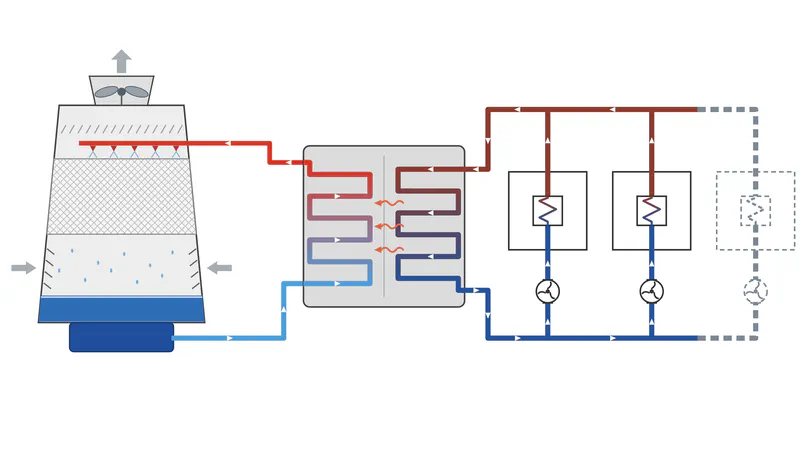
Thermal Management System Optimization
We combine AI and physics-based modeling to optimize the design and operation of data center cooling systems. Using OpenModelica and Dymola, we simulate system dynamics, component interactions, and transient thermal responses under changing workloads and operating conditions. These simulations support the development and evaluation of intelligent control strategies. Machine learning-based surrogate models and physics-informed optimization help us explore design and control choices that balance cooling energy consumption, thermal performance, and operational constraints.
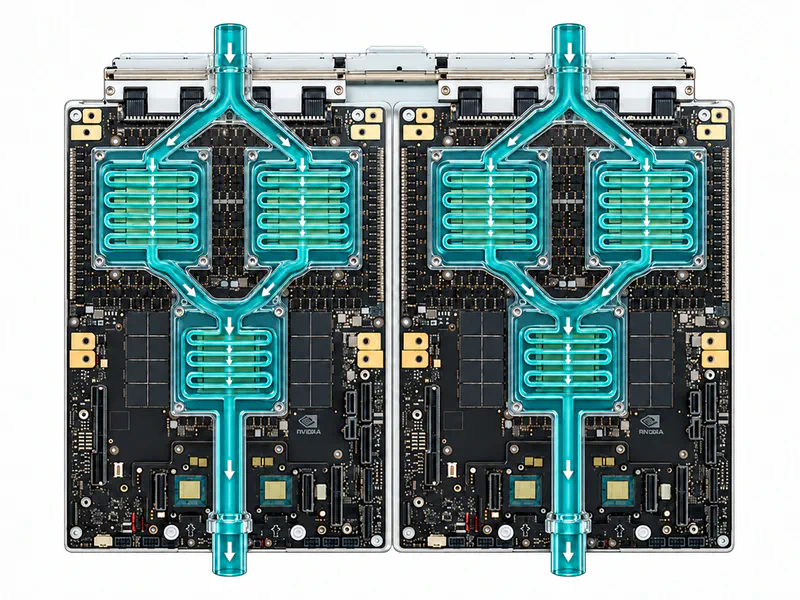
Chip Cooling
We combine AI and physics-based modeling to develop chip-level cooling solutions for high-performance computing. Using ANSYS and OpenFOAM, we simulate single-phase and two-phase cooling to investigate heat transfer, coolant flow distribution, and pressure drop across cooling-channel designs and operating conditions. We develop physics-informed neural networks (PINNs) as reduced-order models of these thermal-fluid systems to support rapid prediction and design exploration. This approach connects detailed simulations with physics-informed optimization for managing chip temperatures and cooling demands.

Electromigration
We use COMSOL Multiphysics to study electromigration in solder joints and examine how geometry and operating conditions affect failure. We combine these physics-based simulations with surrogate modeling to estimate time to failure across design variations. Conformal inference quantifies prediction uncertainty, helping us assess the reliability of electronic interconnects while accounting for geometric variability. This framework supports simulation-informed design evaluation and reliability assessment for advanced electronic packaging.
Aug 25, 2026
Aug 24, 2026
Jun 13, 2026
May 1, 2026
Apr 1, 2026
Mar 1, 2026
Jan 1, 2026
Jan 1, 2025